50 questions · 250 marks · 1 hour — the real CUET pattern · Per subject paper — you choose your subjects.
NTA's Common University Entrance Test (Undergraduate) for admission to central, state and private universities across India. Not one fixed paper — a candidate picks a handful of domain subjects plus optionally the General Test.
Pick one or more subjects, tick the topics you want in each, and choose how many questions you want. You get one combined paper, marked exactly like the real CUET exam.
All 12 subjects and 208 topics of CUET are laid out, each with its own test, alongside the full-length Mock Test built to the real pattern.
No fixed test calendar. Start with the topic your class covered this week, go back to a weak one, or take the full Mock Test when you're ready.
Each topic shows its status and your best score, so you can see what's done, what's weak and what's still to start.
Strong and weak concepts, your score trend, and how your mock and topic results compare — in one place.
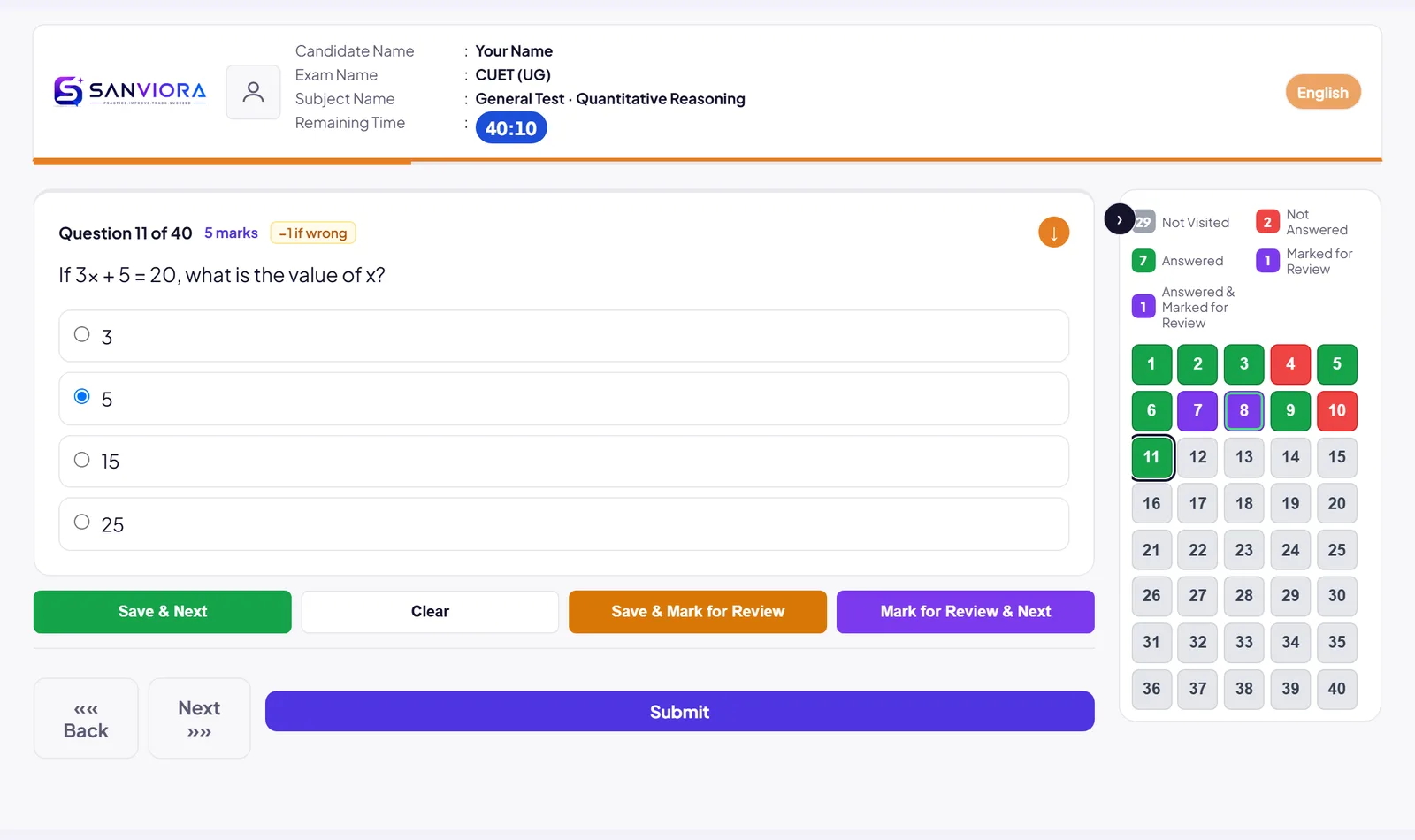
Save & Next, Mark for Review, a question palette and a section timer, laid out like the real computer-based test.
A CUET candidate answers 50 questions worth 250 marks, to be completed in 1 hour (Per subject paper — you choose your subjects). 1 mark deducted for every wrong answer. The table lists every option you can choose from.
| Section | Types | Questions | Marks each | Negative marking | Minutes |
|---|---|---|---|---|---|
| Physics | Single choice | 50 | 5 | −1 | 60 |
| Chemistry | Single choice | 50 | 5 | −1 | 60 |
| Mathematics | Single choice | 50 | 5 | −1 | 60 |
| Biology | Single choice | 50 | 5 | −1 | 60 |
| Accountancy | Single choice | 50 | 5 | −1 | 60 |
| Business Studies | Single choice | 50 | 5 | −1 | 60 |
| Economics | Single choice | 50 | 5 | −1 | 60 |
| History | Single choice | 50 | 5 | −1 | 60 |
| Political Science | Single choice | 50 | 5 | −1 | 60 |
| Psychology | Single choice | 50 | 5 | −1 | 60 |
| English | Single choice | 50 | 5 | −1 | 60 |
| General Test | Single choice | 50 | 5 | −1 | 60 |
| One candidate sits | Per subject paper — you choose your subjects | 50 | 250 marks | 60 min |
Physics: Units & Measurement, Kinematics, Laws of Motion, Work, Energy & Power, Rotational Motion, Gravitation, Mechanical Properties of Solids & Fluids, Thermodynamics, Kinetic Theory of Gases, Oscillations & Waves, Electrostatics, Current Electricity, Magnetic Effects of Current & Magnetism, Electromagnetic Induction & AC, Electromagnetic Waves, Ray & Wave Optics, Dual Nature of Matter & Radiation, Atoms & Nuclei, Semiconductor Electronics
Chemistry: Basic Concepts in Chemistry, Atomic Structure, Chemical Bonding, States of Matter, Thermodynamics, Equilibrium, Redox Reactions & Electrochemistry, Chemical Kinetics, Surface Chemistry, Periodicity & Classification of Elements, General Principles of Metallurgy, Hydrogen, s-Block Elements, p-Block Elements, d & f Block Elements, Coordination Compounds, Environmental Chemistry, Purification & Characterisation of Organic Compounds, Hydrocarbons, Haloalkanes & Haloarenes, Alcohols, Phenols & Ethers, Aldehydes, Ketones & Carboxylic Acids, Amines, Biomolecules & Polymers, Chemistry in Everyday Life
Mathematics: Sets, Relations & Functions, Complex Numbers & Quadratic Equations, Matrices & Determinants, Permutations & Combinations, Binomial Theorem, Sequences & Series, Limits, Continuity & Differentiability, Integral Calculus, Differential Equations, Coordinate Geometry, Three Dimensional Geometry, Vector Algebra, Statistics & Probability, Trigonometry
Biology: Diversity in the Living World, Structural Organisation in Plants, Cell: The Unit of Life, Cell Cycle & Cell Division, Transport in Plants, Mineral Nutrition, Photosynthesis in Higher Plants, Respiration in Plants, Plant Growth & Development, Sexual Reproduction in Flowering Plants, Principles of Inheritance & Variation, Molecular Basis of Inheritance, Evolution, Biotechnology: Principles & Processes, Biotechnology & Its Applications, Organisms & Populations, Ecosystem, Biodiversity & Conservation, Environmental Issues, Animal Kingdom, Structural Organisation in Animals, Digestion & Absorption, Breathing & Exchange of Gases, Body Fluids & Circulation, Excretory Products & Their Elimination, Locomotion & Movement, Neural Control & Coordination, Chemical Coordination & Integration, Human Reproduction, Reproductive Health, Human Health & Disease, Strategies for Enhancement in Food Production, Microbes in Human Welfare
Accountancy: Introduction to Accounting, Theory Base of Accounting, Recording of Transactions (Journal, Ledger, Trial Balance), Bank Reconciliation Statement, Depreciation, Provisions & Reserves, Bills of Exchange, Rectification of Errors, Financial Statements of Sole Proprietorship, Financial Statements of Not-for-Profit Organisations, Accounts from Incomplete Records, Partnership: Fundamentals, Admission, Retirement & Dissolution, Company Accounts: Share & Debenture Capital, Financial Statement Analysis, Cash Flow Statement, Computerised Accounting
Business Studies: Nature and Purpose of Business, Forms of Business Organisation, Public, Private & Global Enterprises, Business Services, Emerging Modes of Business (E-business), Social Responsibility & Business Ethics, Sources of Business Finance, Small Business & Entrepreneurship, Internal Trade, International Business, Nature and Significance of Management, Principles of Management, Business Environment, Planning, Organising, Staffing, Directing, Controlling, Financial Management, Financial Markets, Marketing Management, Consumer Protection
Economics: Introduction to Economics, Collection, Organisation & Presentation of Data, Statistical Tools (Central Tendency, Dispersion, Correlation), Index Numbers, Consumer's Equilibrium & Demand, Producer Behaviour & Supply, Forms of Market & Price Determination, National Income Accounting, Money and Banking, Determination of Income and Employment, Government Budget and the Economy, Balance of Payments & Foreign Exchange, Indian Economy on the Eve of Independence, Indian Economic Development (1950-1990), Liberalisation, Privatisation & Globalisation, Poverty, Human Capital & Employment, Infrastructure & Sustainable Development
History: Bricks, Beads and Bones (Harappan Civilisation), Kings, Farmers and Towns (Early States), Kinship, Caste and Class (Early Societies), Thinkers, Beliefs and Buildings, Through the Eyes of Travellers, Bhakti-Sufi Traditions, An Imperial Capital: Vijayanagara, Peasants, Zamindars and the State (Mughal Empire), Kings and Chronicles: The Mughal Courts, Colonialism and the Countryside, Rebels and the Raj (Revolt of 1857), Colonial Cities: Urbanisation, Planning & Architecture, Mahatma Gandhi and the Nationalist Movement, Understanding Partition, Framing the Indian Constitution
Political Science: Constitution: Why and How, Rights in the Indian Constitution, Election and Representation, Executive, Legislature & Judiciary, Federalism, Local Governments, Cold War Era, End of Bipolarity, US Hegemony in World Politics, Alternative Centres of Power, Contemporary South Asia, International Organisations (UN), Security in Contemporary World, Environment and Natural Resources, Globalisation, Era of One-Party Dominance, Politics of Planned Development, Rise of Popular Movements, Regional Aspirations
Psychology: What is Psychology?, Methods of Enquiry in Psychology, The Bases of Human Behaviour, Human Development, Sensory, Attentional & Perceptual Processes, Learning, Human Memory, Thinking, Motivation and Emotion, Variations in Psychological Attributes (Intelligence, Aptitude), Self and Personality, Meeting Life Challenges (Stress & Coping), Psychological Disorders, Therapeutic Approaches, Attitude and Social Cognition, Social Influence and Group Processes
English: Reading Comprehension (Factual, Narrative, Literary Passages), Verbal Ability (Synonyms, Antonyms, Analogies), Vocabulary in Context, Grammar & Usage, Rearrangement of Sentences, Literary Aptitude (Figures of Speech, Poetic Devices), One-word Substitution, Idioms & Phrases
General Test: General Knowledge & Current Affairs, General Mental Ability, Numerical Ability, Quantitative Reasoning (Arithmetic, Algebra, Geometry, Mensuration), Logical and Analytical Reasoning
A CUET candidate answers 50 questions worth 250 marks in 1 hour (Per subject paper — you choose your subjects). The pattern table below lists every option.
1 mark deducted for every wrong answer.
CUET covers Physics, Chemistry, Mathematics, Biology, Accountancy, Business Studies, Economics, History, Political Science, Psychology, English and General Test. On Sanviora every subject and topic is listed with its own test, alongside a full Mock Test built to the real pattern.
Yes — alongside a full-length Mock Test built to the real CUET pattern, you can test any single topic or a whole subject in one click, or build your own test from the subjects, topics and question types you choose.
Plans start from ₹99 — pay once per plan, no subscription required.
No — there is no fixed test calendar. Start with the topic you studied this week, go back to a weak one, or take the full CUET Mock Test when you're ready. Each topic shows its status and your best score as you go.
Yes — question counts, marks per question, section structure and negative marking all follow the real, published CUET pattern rather than a generic quiz format.
