150 questions · 200 marks · 3 hours — the real MHT-CET pattern · With Mathematics — or Biology instead.
Maharashtra's State CET Cell entrance test for engineering, technology and pharmacy courses. Physics and Chemistry are always required, plus either Mathematics (Engineering) or Biology (Pharmacy).
Pick one or more subjects, tick the topics you want in each, and choose how many questions you want. You get one combined paper, marked exactly like the real MHT-CET exam.
All 4 subjects and 91 topics of MHT-CET are laid out, each with its own test, alongside the full-length Mock Test built to the real pattern.
No fixed test calendar. Start with the topic your class covered this week, go back to a weak one, or take the full Mock Test when you're ready.
Each topic shows its status and your best score, so you can see what's done, what's weak and what's still to start.
Strong and weak concepts, your score trend, and how your mock and topic results compare — in one place.
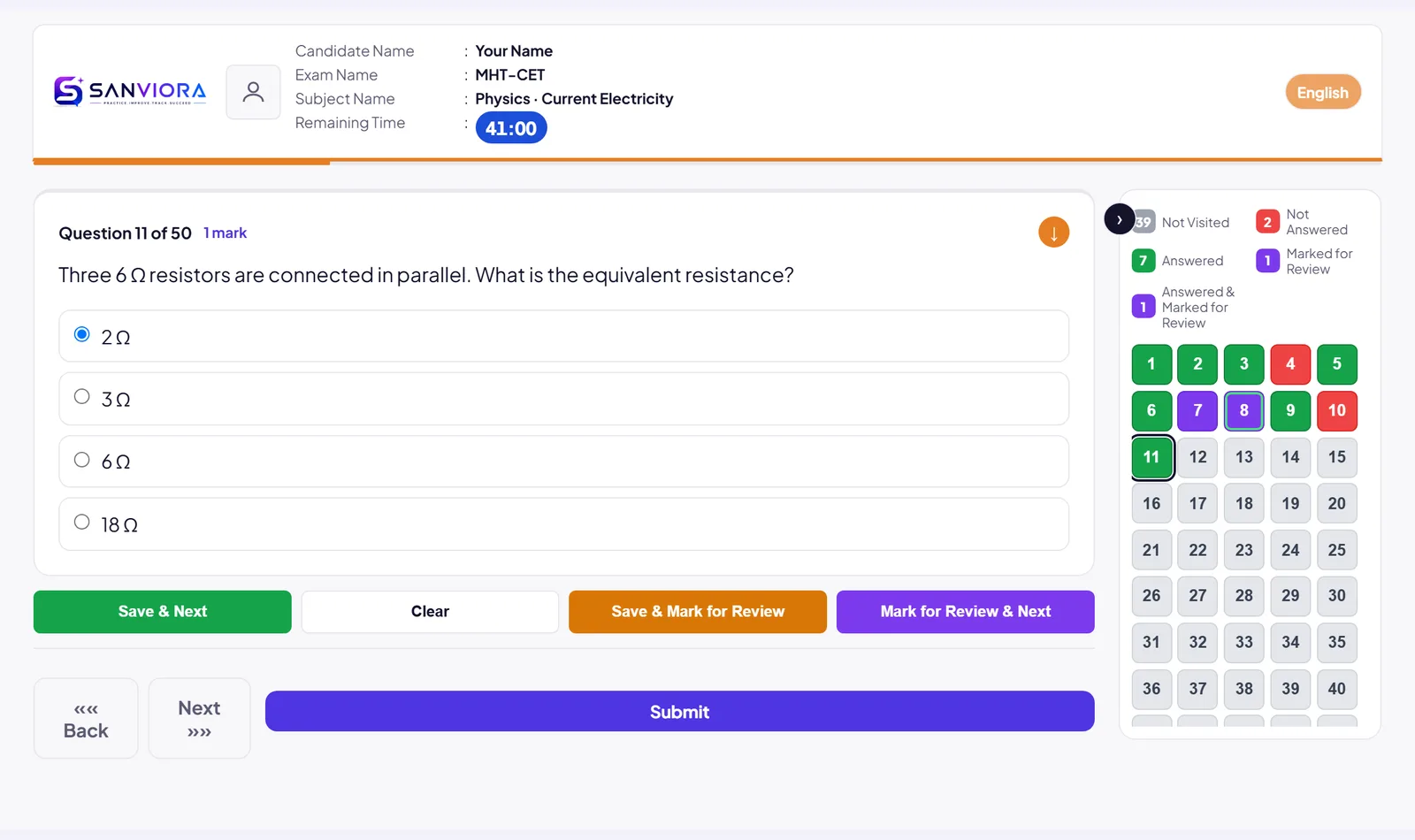
Save & Next, Mark for Review, a question palette and a section timer, laid out like the real computer-based test.
A MHT-CET candidate answers 150 questions worth 200 marks, to be completed in 3 hours (With Mathematics — or Biology instead). No negative marking on any question. The table lists every option you can choose from.
| Section | Types | Questions | Marks each | Negative marking | Minutes |
|---|---|---|---|---|---|
| Physics | Single choice | 50 | 1 | None | 45 |
| Chemistry | Single choice | 50 | 1 | None | 45 |
| Mathematics | Single choice | 50 | 2 | None | 90 |
| Biology — Part 1 | Single choice | 50 | 1 | None | 45 |
| Biology — Part 2 | Single choice | 50 | 1 | None | 45 |
| One candidate sits | With Mathematics — or Biology instead | 150 | 200 marks | 180 min |
Physics: Units & Measurement, Kinematics, Laws of Motion, Work, Energy & Power, Rotational Motion, Gravitation, Mechanical Properties of Solids & Fluids, Thermodynamics, Kinetic Theory of Gases, Oscillations & Waves, Electrostatics, Current Electricity, Magnetic Effects of Current & Magnetism, Electromagnetic Induction & AC, Electromagnetic Waves, Ray & Wave Optics, Dual Nature of Matter & Radiation, Atoms & Nuclei, Semiconductor Electronics
Chemistry: Basic Concepts in Chemistry, Atomic Structure, Chemical Bonding, States of Matter, Thermodynamics, Equilibrium, Redox Reactions & Electrochemistry, Chemical Kinetics, Surface Chemistry, Periodicity & Classification of Elements, General Principles of Metallurgy, Hydrogen, s-Block Elements, p-Block Elements, d & f Block Elements, Coordination Compounds, Environmental Chemistry, Purification & Characterisation of Organic Compounds, Hydrocarbons, Haloalkanes & Haloarenes, Alcohols, Phenols & Ethers, Aldehydes, Ketones & Carboxylic Acids, Amines, Biomolecules & Polymers, Chemistry in Everyday Life
Mathematics: Sets, Relations & Functions, Complex Numbers & Quadratic Equations, Matrices & Determinants, Permutations & Combinations, Binomial Theorem, Sequences & Series, Limits, Continuity & Differentiability, Integral Calculus, Differential Equations, Coordinate Geometry, Three Dimensional Geometry, Vector Algebra, Statistics & Probability, Trigonometry
Biology: Diversity in the Living World, Structural Organisation in Plants, Cell: The Unit of Life, Cell Cycle & Cell Division, Transport in Plants, Mineral Nutrition, Photosynthesis in Higher Plants, Respiration in Plants, Plant Growth & Development, Sexual Reproduction in Flowering Plants, Principles of Inheritance & Variation, Molecular Basis of Inheritance, Evolution, Biotechnology: Principles & Processes, Biotechnology & Its Applications, Organisms & Populations, Ecosystem, Biodiversity & Conservation, Environmental Issues, Animal Kingdom, Structural Organisation in Animals, Digestion & Absorption, Breathing & Exchange of Gases, Body Fluids & Circulation, Excretory Products & Their Elimination, Locomotion & Movement, Neural Control & Coordination, Chemical Coordination & Integration, Human Reproduction, Reproductive Health, Human Health & Disease, Strategies for Enhancement in Food Production, Microbes in Human Welfare
A MHT-CET candidate answers 150 questions worth 200 marks in 3 hours (With Mathematics — or Biology instead). The pattern table below lists every option.
No negative marking on any question.
MHT-CET covers Physics, Chemistry, Mathematics and Biology. On Sanviora every subject and topic is listed with its own test, alongside a full Mock Test built to the real pattern.
Yes — alongside a full-length Mock Test built to the real MHT-CET pattern, you can test any single topic or a whole subject in one click, or build your own test from the subjects, topics and question types you choose.
Plans start from ₹99 — pay once per plan, no subscription required.
No — there is no fixed test calendar. Start with the topic you studied this week, go back to a weak one, or take the full MHT-CET Mock Test when you're ready. Each topic shows its status and your best score as you go.
Yes — question counts, marks per question, section structure all follow the real, published MHT-CET pattern rather than a generic quiz format.
