65 questions · 100 marks · 3 hours — the real GATE pattern · Shared paper + one subject of your choice.
The Graduate Aptitude Test in Engineering (IITs/IISc) for M.Tech/PhD admission and PSU recruitment. Not one fixed paper — a candidate takes exactly one discipline paper plus the General Aptitude component every discipline shares.
Pick one or more subjects, tick the topics you want in each, and choose how many single choice and numerical questions you want. You get one combined paper, marked exactly like the real GATE exam.
All 7 subjects and 68 topics of GATE are laid out, each with its own test, alongside the full-length Mock Test built to the real pattern.
No fixed test calendar. Start with the topic your class covered this week, go back to a weak one, or take the full Mock Test when you're ready.
Each topic shows its status and your best score, so you can see what's done, what's weak and what's still to start.
Strong and weak concepts, your score trend, and how your mock and topic results compare — in one place.
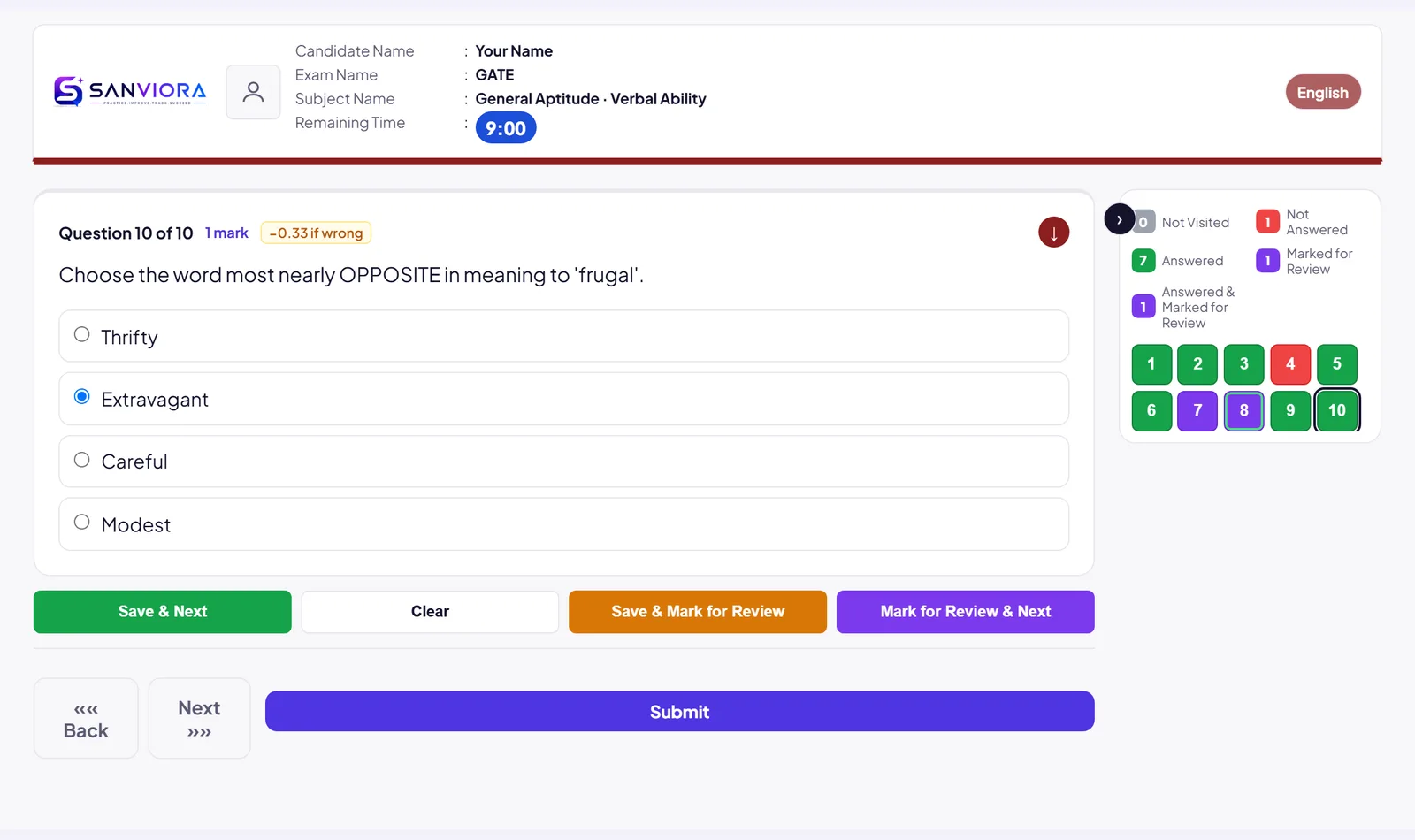
Save & Next, Mark for Review, a question palette and a section timer, laid out like the real computer-based test.
A GATE candidate answers 65 questions worth 100 marks, to be completed in 3 hours (Shared paper + one subject of your choice). Negative marking applies to some question types (up to 0.67 marks deducted per wrong answer) — see the pattern table below. The table lists every option you can choose from.
| Section | Types | Questions | Marks each | Negative marking | Minutes |
|---|---|---|---|---|---|
| General Aptitude (1 mark) | Single choice | 5 | 1 | −0.33 | 10 |
| General Aptitude (2 mark) | Single choice | 5 | 2 | −0.67 | 20 |
| Computer Science & IT — Subject (1 mark, MCQ) | Single choice | 18 | 1 | −0.33 | 47 |
| Computer Science & IT — Subject (1 mark, NAT) | Numerical | 7 | 1 | None | 18 |
| Computer Science & IT — Subject (2 mark, MCQ) | Single choice | 22 | 2 | −0.67 | 62 |
| Computer Science & IT — Subject (2 mark, NAT) | Numerical | 8 | 2 | None | 23 |
| Mechanical Engineering — Subject (1 mark, MCQ) | Single choice | 18 | 1 | −0.33 | 47 |
| Mechanical Engineering — Subject (1 mark, NAT) | Numerical | 7 | 1 | None | 18 |
| Mechanical Engineering — Subject (2 mark, MCQ) | Single choice | 22 | 2 | −0.67 | 62 |
| Mechanical Engineering — Subject (2 mark, NAT) | Numerical | 8 | 2 | None | 23 |
| Electrical Engineering — Subject (1 mark, MCQ) | Single choice | 18 | 1 | −0.33 | 47 |
| Electrical Engineering — Subject (1 mark, NAT) | Numerical | 7 | 1 | None | 18 |
| Electrical Engineering — Subject (2 mark, MCQ) | Single choice | 22 | 2 | −0.67 | 62 |
| Electrical Engineering — Subject (2 mark, NAT) | Numerical | 8 | 2 | None | 23 |
| Civil Engineering — Subject (1 mark, MCQ) | Single choice | 18 | 1 | −0.33 | 47 |
| Civil Engineering — Subject (1 mark, NAT) | Numerical | 7 | 1 | None | 18 |
| Civil Engineering — Subject (2 mark, MCQ) | Single choice | 22 | 2 | −0.67 | 62 |
| Civil Engineering — Subject (2 mark, NAT) | Numerical | 8 | 2 | None | 23 |
| Electronics & Communication Engineering — Subject (1 mark, MCQ) | Single choice | 18 | 1 | −0.33 | 47 |
| Electronics & Communication Engineering — Subject (1 mark, NAT) | Numerical | 7 | 1 | None | 18 |
| Electronics & Communication Engineering — Subject (2 mark, MCQ) | Single choice | 22 | 2 | −0.67 | 62 |
| Electronics & Communication Engineering — Subject (2 mark, NAT) | Numerical | 8 | 2 | None | 23 |
| Chemical Engineering — Subject (1 mark, MCQ) | Single choice | 18 | 1 | −0.33 | 47 |
| Chemical Engineering — Subject (1 mark, NAT) | Numerical | 7 | 1 | None | 18 |
| Chemical Engineering — Subject (2 mark, MCQ) | Single choice | 22 | 2 | −0.67 | 62 |
| Chemical Engineering — Subject (2 mark, NAT) | Numerical | 8 | 2 | None | 23 |
| One candidate sits | Shared paper + one subject of your choice | 65 | 100 marks | 180 min |
General Aptitude: Verbal Aptitude, Quantitative Aptitude, Analytical Aptitude, Spatial Aptitude
Computer Science & IT: Engineering Mathematics (Discrete Math, Linear Algebra, Calculus, Probability), Digital Logic, Computer Organization & Architecture, Programming & Data Structures, Algorithms, Theory of Computation, Compiler Design, Operating Systems, Databases, Computer Networks
Mechanical Engineering: Engineering Mathematics, Engineering Mechanics, Mechanics of Materials, Theory of Machines, Vibrations, Machine Design, Fluid Mechanics, Heat Transfer, Thermodynamics, IC Engines, Refrigeration & Turbomachinery, Engineering Materials, Casting, Forming & Joining, Machining & Machine Tool Operations, Metrology & Inspection, Production Planning & Control, Inventory Control & Operations Research
Electrical Engineering: Engineering Mathematics, Electric Circuits, Electromagnetic Fields, Signals & Systems, Electrical Machines, Power Systems, Control Systems, Electrical & Electronic Measurements, Analog & Digital Electronics, Power Electronics
Civil Engineering: Engineering Mathematics, Structural Analysis, Concrete Structures, Steel Structures, Soil Mechanics, Foundation Engineering, Fluid Mechanics & Hydraulics, Hydrology & Irrigation, Environmental Engineering (Water, Air, Solid Waste), Transportation Engineering, Geomatics Engineering (Surveying)
Electronics & Communication Engineering: Engineering Mathematics, Networks, Signals & Systems, Electronic Devices, Analog Circuits, Digital Circuits, Control Systems, Communications, Electromagnetics
Chemical Engineering: Engineering Mathematics, Process Calculations & Thermodynamics, Fluid Mechanics & Mechanical Operations, Heat Transfer, Mass Transfer, Chemical Reaction Engineering, Instrumentation & Process Control, Plant Design & Economics, Chemical Technology
A GATE candidate answers 65 questions worth 100 marks in 3 hours (Shared paper + one subject of your choice). The pattern table below lists every option.
Negative marking applies to some question types (up to 0.67 marks deducted per wrong answer) — see the pattern table below.
GATE covers General Aptitude, Computer Science & IT, Mechanical Engineering, Electrical Engineering, Civil Engineering, Electronics & Communication Engineering and Chemical Engineering. On Sanviora every subject and topic is listed with its own test, alongside a full Mock Test built to the real pattern.
Yes — alongside a full-length Mock Test built to the real GATE pattern, you can test any single topic or a whole subject in one click, or build your own test from the subjects, topics and question types you choose.
Plans start from ₹149 — pay once per plan, no subscription required.
No — there is no fixed test calendar. Start with the topic you studied this week, go back to a weak one, or take the full GATE Mock Test when you're ready. Each topic shows its status and your best score as you go.
Yes — question counts, marks per question, section structure and negative marking all follow the real, published GATE pattern rather than a generic quiz format.
