150 questions · 300 marks · 3 hours — the real UGC NET pattern · Shared paper + one subject of your choice.
NTA's National Eligibility Test for Assistant Professor / Junior Research Fellowship eligibility at Indian universities. Not one fixed paper — a candidate takes Paper 1 (common to everyone) plus Paper 2, their chosen subject.
Pick one or more subjects, tick the topics you want in each, and choose how many questions you want. You get one combined paper, marked exactly like the real UGC NET exam.
All 9 subjects and 89 topics of UGC NET are laid out, each with its own test, alongside the full-length Mock Test built to the real pattern.
No fixed test calendar. Start with the topic your class covered this week, go back to a weak one, or take the full Mock Test when you're ready.
Each topic shows its status and your best score, so you can see what's done, what's weak and what's still to start.
Strong and weak concepts, your score trend, and how your mock and topic results compare — in one place.
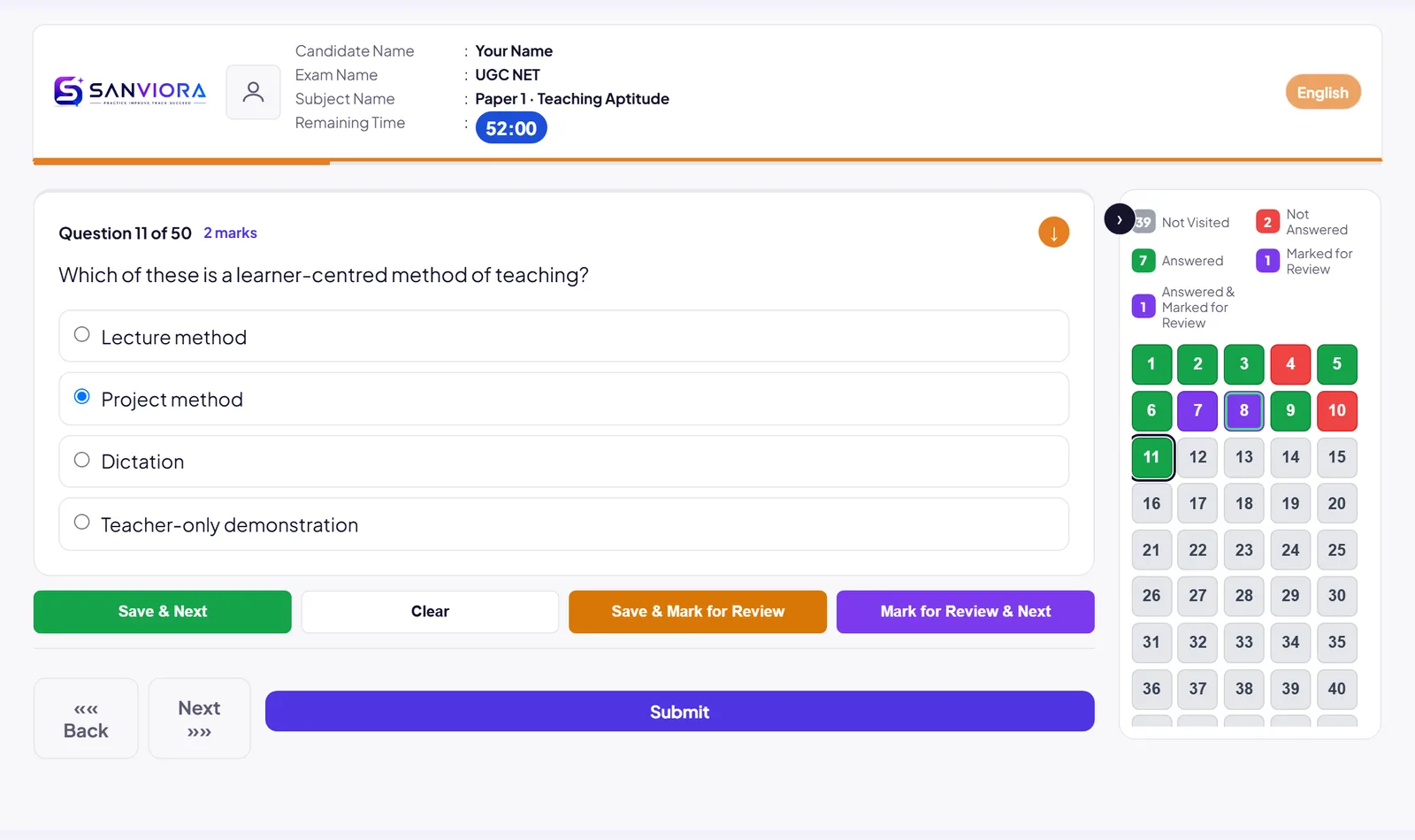
Save & Next, Mark for Review, a question palette and a section timer, laid out like the real computer-based test.
A UGC NET candidate answers 150 questions worth 300 marks, to be completed in 3 hours (Shared paper + one subject of your choice). No negative marking on any question. The table lists every option you can choose from.
| Section | Types | Questions | Marks each | Negative marking | Minutes |
|---|---|---|---|---|---|
| Paper 1 — Teaching & Research Aptitude | Single choice | 50 | 2 | None | 60 |
| Paper 2 — Commerce — Part 1 | Single choice | 50 | 2 | None | 60 |
| Paper 2 — Commerce — Part 2 | Single choice | 50 | 2 | None | 60 |
| Paper 2 — Economics — Part 1 | Single choice | 50 | 2 | None | 60 |
| Paper 2 — Economics — Part 2 | Single choice | 50 | 2 | None | 60 |
| Paper 2 — English — Part 1 | Single choice | 50 | 2 | None | 60 |
| Paper 2 — English — Part 2 | Single choice | 50 | 2 | None | 60 |
| Paper 2 — Education — Part 1 | Single choice | 50 | 2 | None | 60 |
| Paper 2 — Education — Part 2 | Single choice | 50 | 2 | None | 60 |
| Paper 2 — History — Part 1 | Single choice | 50 | 2 | None | 60 |
| Paper 2 — History — Part 2 | Single choice | 50 | 2 | None | 60 |
| Paper 2 — Political Science — Part 1 | Single choice | 50 | 2 | None | 60 |
| Paper 2 — Political Science — Part 2 | Single choice | 50 | 2 | None | 60 |
| Paper 2 — Sociology — Part 1 | Single choice | 50 | 2 | None | 60 |
| Paper 2 — Sociology — Part 2 | Single choice | 50 | 2 | None | 60 |
| Paper 2 — Computer Science & Applications — Part 1 | Single choice | 50 | 2 | None | 60 |
| Paper 2 — Computer Science & Applications — Part 2 | Single choice | 50 | 2 | None | 60 |
| One candidate sits | Shared paper + one subject of your choice | 150 | 300 marks | 180 min |
Paper 1 — Teaching & Research Aptitude: Teaching Aptitude, Research Aptitude, Reading Comprehension, Communication, Mathematical & Logical Reasoning, Data Interpretation, Information & Communication Technology (ICT), People, Development & Environment, Higher Education System: Governance, Polity & Administration
Commerce: Business Environment & International Business, Accounting & Auditing, Business Economics, Business Finance, Business Statistics & Research Methods, Business Management & Human Resource Management, Banking & Financial Institutions, Marketing Management, Legal Aspects of Business, Income Tax & Corporate Tax Planning
Economics: Microeconomics, Macroeconomics, Statistics & Econometrics, Mathematical Economics, International Economics, Public Economics, Environmental Economics, Growth & Development Economics, Indian Economy, Agricultural & Rural Economics
English: British Literature, American Literature, Indian Writing in English, New Literatures in English, Literary Theory & Criticism, Linguistics & Phonetics, Drama, Poetry, Fiction, Research Methods in English Studies
Education: Philosophical & Sociological Foundations of Education, Development of Education in India, Research Methodology, Teacher Education, Educational Psychology, Educational Technology, Educational Measurement & Evaluation, Curriculum Development, Guidance & Counselling, Comparative Education
History: Ancient India, Early Medieval India, Delhi Sultanate & Mughal Period, Modern India (Colonial Period), Indian National Movement, World History, Historiography, Art & Architecture, Economic History of India, Post-Independence India
Political Science: Political Theory, Indian Government & Politics, Comparative Politics, International Relations, Public Administration, Indian Political Thought, Western Political Thought, Indian Constitution, Foreign Policy of India, Political Sociology
Sociology: Sociology as a Discipline, Sociological Thinkers, Research Methodology, Social Stratification, Social Institutions (Family, Marriage, Kinship), Social Change & Development, Indian Society, Rural & Urban Sociology, Gender & Society, Sociology of Religion
Computer Science & Applications: Discrete Structures, Computer Arithmetic, Programming in C/C++/Java, Data Structures, Algorithm Design, Computer Organization & Architecture, Operating Systems, Databases, Software Engineering, Computer Networks
A UGC NET candidate answers 150 questions worth 300 marks in 3 hours (Shared paper + one subject of your choice). The pattern table below lists every option.
No negative marking on any question.
UGC NET covers Paper 1 — Teaching & Research Aptitude, Commerce, Economics, English, Education, History, Political Science, Sociology and Computer Science & Applications. On Sanviora every subject and topic is listed with its own test, alongside a full Mock Test built to the real pattern.
Yes — alongside a full-length Mock Test built to the real UGC NET pattern, you can test any single topic or a whole subject in one click, or build your own test from the subjects, topics and question types you choose.
Plans start from ₹99 — pay once per plan, no subscription required.
No — there is no fixed test calendar. Start with the topic you studied this week, go back to a weak one, or take the full UGC NET Mock Test when you're ready. Each topic shows its status and your best score as you go.
Yes — question counts, marks per question, section structure all follow the real, published UGC NET pattern rather than a generic quiz format.
